AI Inventory Decision Making in Practice: iShop.X90 Uses Outbound Stock Records to Suggest Replenishment, with Human Review for Peace of Mind
Retail is embracing AI inventory management. The iShop.X90 online store system uses outbound stock records to automatically suggest replenishment quantities and reorder points, but insists on human confirmation — numbers change only when accepted, and stay as they are when rejected. AI does not change inventory balances or automatically create purchase orders, giving chain stores and online store operators a basis for replenishment and confidence in their decisions.

Time & Payroll Suite
Attendance, Payroll and Access Control Solution for Cost Reduction and Productivity Gains Details
All‑in‑one automated timekeeping and payroll system with robust, secure processes to guarantee payroll integrity. Includes leave management, shift rostering, multi‑site and chain support, multi‑ledger accounting, and comprehensive modules.
Under the Retail AI Boom, How Can Inventory Decisions Stay on Track?
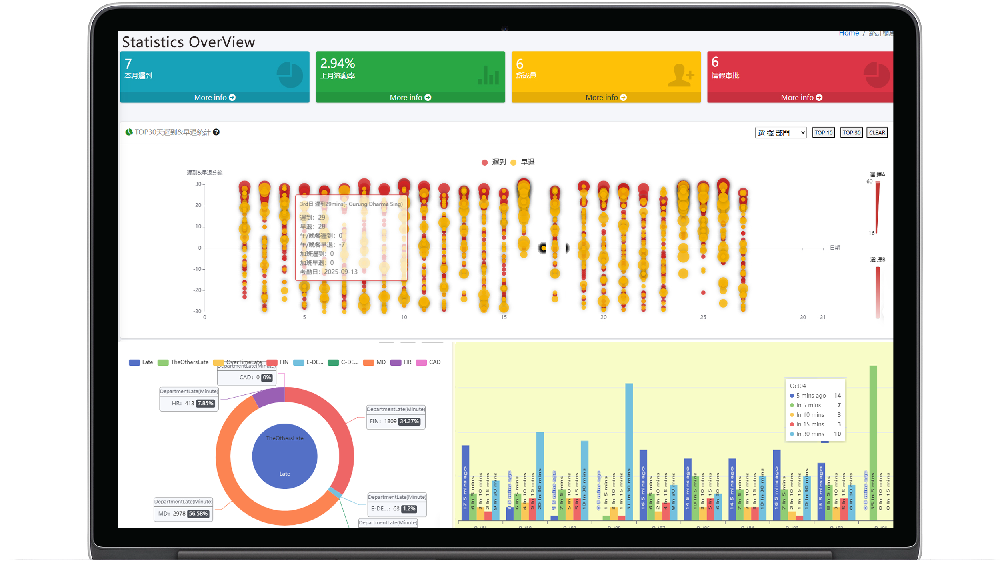
The hottest topic in retail recently is undoubtedly AI inventory management. Many operators hope AI can solve the dilemma of overstock and stockouts, yet they also worry about the system "making its own decisions" and changing the numbers. The iShop.X90 online store system, with AI-driven online stores at its core, has launched an AI inventory decision feature that suggests replenishment quantities and reorder points based on outbound warehouse transaction records—but the key step is always left to people: the numbers are only changed after a person confirms. This article will walk you through how this system helps chain stores and online store operators achieve a balance between simple inventory management and dynamic reminders under a supply chain-driven architecture.
Basic Inventory Management: One Ledger, Clear Transactions
iShop.X90's inventory management starts with the fundamentals. On-hand, reserved, and available quantities are recorded in the same ledger, and receiving, outbound, and returns all leave transaction records, so every movement is traceable. Physical warehouses are used to manage warehouses, goods, and inbound/outbound flows; stores and warehouses share the same ledger, online store orders deduct from the same inventory set, and out-of-stock reordering and distribution shipping also return to this inventory set. The main warehouse and branches replenish and ship together, no longer keeping separate books, avoiding duplicate deductions or missed records.
This design is especially important for chain stores. Previously, main store and branch inventories operated independently, and stock transfers often led to the awkward situation of "on the books but not in reality." Now all channels share the same inventory set, whether it is online store distribution, store sales, or warehouse transfers, all are reflected in real time, and inventory accuracy naturally improves.
AI Inventory Decisions: Suggestions Based on Outbound Warehouse Transactions, Effective Only After Human Confirmation
AI inventory decisions are a highlight feature of iShop.X90. The system analyzes outbound warehouse transaction records, comprehensively considering outbound item counts, available quantities, and reorder points, and proactively suggests replenishment quantities and reorder points. When you receive a suggestion, you can choose to accept or reject it: the numbers are changed only if accepted, and remain unchanged if rejected. AI does not change inventory balances, nor does it automatically create purchase orders—people are fully in control. This means operators still hold the final decision-making power, and AI is merely an assistant providing data support.
For products with low shipments and high inventory, the system will flag them as slow-moving or overstocked, along with reasons, such as low outbound item counts, excessively high available quantities, or improperly set reorder points. At the same time, the system may suggest response measures such as promotions, store transfers, stopping replenishment, or lowering reorder points. However, if shipments are truly too low, the system will only explain the situation and not provide an adoptable quantity, avoiding misleading. This design of "explaining without overstepping" makes AI suggestions more valuable for reference and does not cause confusion.
Supply Chain-Driven: Independent System, Connecting Online Stores and Physical Stores
iShop.X90's supply chain system is independent of any single online store, which means that even if you operate multiple online stores, the supply chain can still be managed uniformly. Products, categories, brands, and specifications are maintained once; orders, shipping fees, and statuses follow the same process; activities, content, and search can be configured by language. Multi-site data is kept separate, accounts can switch stores, storefronts are multilingual, and the backend supports Traditional Chinese, Simplified Chinese, and English, suitable for operators in Hong Kong, mainland China, and international markets.
This architecture enables seamless collaboration between chain stores and online store distribution. Online store orders deduct from the same inventory set, out-of-stock reordering and distribution shipping return to this inventory set, and the main warehouse and branches replenish and ship together, forming a dynamic management closed loop from supply chain to inventory and sales. Operators can clearly grasp the inventory and sales status of each store from the backend and adjust strategies in a timely manner.
Purchasing Key Points: AI-Assisted, Human-Centered
When choosing an inventory management system, rather than pursuing full automation, it is better to choose a "human-machine collaboration" design. iShop.X90's AI inventory decisions emphasize human confirmation, avoiding the risks brought by automation. At the same time, the system's independent supply chain, physical warehouse management, and shared inventory ledger can meet the complex needs of multi-channel operations. Pricing is based on self-provided interfaces or platform monthly Tokens; monthly fees are shown on the public page, transparent and flexible.
In summary, the iShop.X90 online store system, with AI-driven online stores, positions AI inventory decisions as an auxiliary role, allowing operators to have data to rely on when facing overstock and slow-moving goods, without worrying about the system making unauthorized changes. For chain stores and online stores pursuing steady operations, this is exactly a solution worth considering.































Featured Reviews
No reviews yet. Be the first to leave one.
Write a review
Supports bold and lists; do not paste external scripts or images
0 / 2000
Visible after review