Solving Overstock and Slow-Moving Inventory: iShop.X90 Uses Data to Flag Issues and Suggest Promotions and Store Transfers
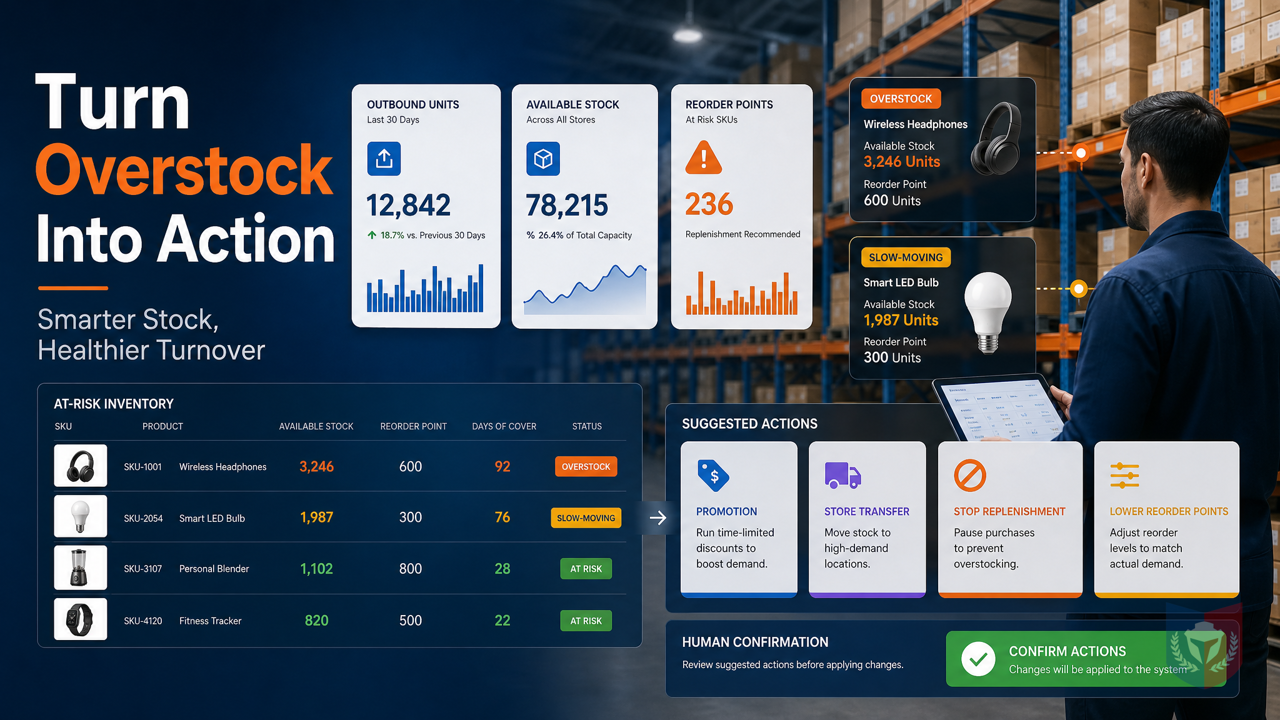
Understand the inventory pain points of chain online stores at a glance: how the AI-driven iShop.X90 online store system uses outbound units, available quantity, and reorder point to flag overstock and slow-moving inventory, and after manual confirmation suggests promotions, store transfers, stopping replenishment, or lowering the reorder point, making inventory turnover healthier.
Time & Payroll Suite
Attendance, Payroll and Access Control Solution for Cost Reduction and Productivity Gains Details
All‑in‑one automated timekeeping and payroll system with robust, secure processes to guarantee payroll integrity. Includes leave management, shift rostering, multi‑site and chain support, multi‑ledger accounting, and comprehensive modules.
Overstock and Slow-Moving Inventory: The Pain Chain Stores Can't Voice
Running an online store or a chain, the biggest fear isn't a lack of business—it's goods that won't sell and warehouses that keep filling up. The backend clearly shows inventory, yet frontline staff always feel that "there aren't many sellable items." A certain product ships pitifully few units, yet purchasing keeps restocking it. These scenarios, plainly put, mean overstock and slow-moving inventory aren't being detected in time, and inventory management is still stuck at the stage of "looking at numbers and going by feel."
iShop.X90 online store system was born precisely for this. It is an AI-driven online store system that puts products, orders, inventory, supply chain, and store data into the same logic, so operators can not only see "how much stock there is now" but also understand "why this stock isn't moving."
Start with Basic Inventory Management and Get the Books Right
To solve overstock and slow-moving inventory, the first step is accurate books. iShop.X90's basic inventory management keeps on-hand, reserved, and available quantities in the same ledger, with receiving, outbound, and returns all leaving a transaction trail—every movement is traceable. Physical warehouses manage warehouses, goods, and inbound/outbound, stores and warehouses share the same ledger, online store orders deduct from the same inventory set, reordering on shortage and distribution shipping return to this inventory set, and the main warehouse and branches replenish and ship together. In other words, whether it's online store shipping, store retail, or distribution transfers, everything returns to the same inventory logic—no more muddled books where "it's deducted here but not there."
With accurate books, AI inventory decisions become meaningful. iShop.X90 suggests replenishment quantities and reorder points based on outbound transaction records, and on the basis of maintaining products, categories, brands, and specifications in one place, the turnover performance of each SKU is clear at a glance.
AI Inventory Decisions: Use Data to Flag Overstock and Slow-Moving Items
The core of iShop.X90's AI inventory decisions is "letting data speak." When the system observes low shipments and high inventory, it flags the item as slow-moving or overstocked, and the reason must include outbound units, available quantity, and reorder point—not a vague "it's not selling well." This way, operators can clearly know where the problem lies: is the outbound unit count persistently low? Or is the available quantity far above the reorder point? Different causes correspond to different handling methods.
For flagged products, the system can suggest promotions, store transfers, stopping replenishment, or lowering the reorder point. For example, if a product ships few units at Store A but Store B still has demand, a store transfer may be a more cost-effective choice than a promotion; if overall shipments are low, a promotion or stopping replenishment can be considered; if only the reorder point is set too high, lowering it can avoid unnecessary replenishment. These suggestions are not commands but references. Too few shipments are only explained, without giving an adoptable quantity, preventing operators from being led by the numbers.
Most importantly: AI does not change inventory balances, nor does it automatically create purchase orders. All number changes must be confirmed by a person—accept to change the numbers, reject to keep them as they are. This model of "AI gives suggestions, people make decisions" makes inventory management both smart and controllable, without new risks arising from the system acting on its own.
Supply Chain Driven, So Chain Online Stores Can Run Smoothly
iShop.X90's supply chain system is independent of any single online store, meaning chain brands can let multiple online stores, multiple stores, and warehouses share the same supply chain logic. Multi-site data is kept separate, and accounts can switch stores, so operators can easily switch between different sites; storefronts are multilingual, and the backend uses Traditional Chinese, Simplified Chinese, and English, so frontline staff have no language barrier. Campaigns, content, and search can be configured by language, so marketing campaigns won't be missed due to different language versions.
In order processing, orders, shipping fees, and status follow the same flow, making everything clear from order placement to shipment. Products, categories, brands, and specifications are maintained in one place, reducing duplicate entry and human error. For chain store and online store operators, this means less administrative friction, faster response times, and healthier inventory turnover.
Purchasing Points and Reporting Talking Points
If you're evaluating an online store system that can solve overstock and slow-moving inventory, pay attention to the following:
- Is inventory truly "the same ledger"? Do stores, warehouses, online stores, and distribution share the same inventory set?
- Are AI suggestions well-founded? Can they state outbound units, available quantity, and reorder point?
- Is the manual confirmation mechanism clear? Will AI arbitrarily change numbers or create purchase orders?
- Is the supply chain independent of a single online store? Can multiple sites and stores coordinate replenishment and outbound shipping?
- Does the backend support Traditional Chinese, Simplified Chinese, and English? Is the multilingual storefront convenient for local operations?
iShop.X90's design in these areas moves inventory management from "after-the-fact remediation" to "advance reminders." Rather than waiting until the warehouse is full to cut prices and clear stock, it's better to let the system flag early and suggest early, minimizing the losses from overstock and slow-moving inventory.
Pricing and Implementation
iShop.X90 uses public pricing, with your own interface or platform monthly Token; see the public page for the monthly fee. We do not recommend custom monthly fees, inventory numbers, or unlisted features—everything is subject to the public page. If you want to see for yourself how AI inventory decisions flag overstock and slow-moving inventory and how they give promotion and store transfer suggestions, welcome to book a demo and let data help you decide.
Overstock and slow-moving inventory is not an incurable disease; the key is whether you use the right tool. iShop.X90 uses an AI-driven online store system to turn inventory management into a competitive advantage for chain online stores.































Featured Reviews
No reviews yet. Be the first to leave one.
Write a review
Supports bold and lists; do not paste external scripts or images
0 / 2000
Visible after review