Innovation and Practice of Enterprise-Level Generative AI Applications
The rise of generative AI in the enterprise market
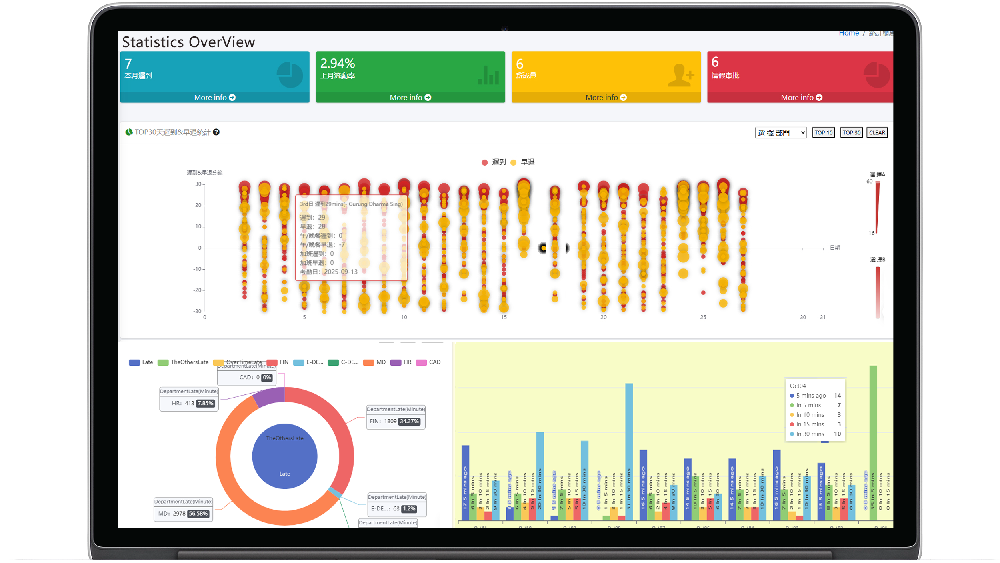
Time & Payroll Suite
Attendance, Payroll and Access Control Solution for Cost Reduction and Productivity Gains Details
All‑in‑one automated timekeeping and payroll system with robust, secure processes to guarantee payroll integrity. Includes leave management, shift rostering, multi‑site and chain support, multi‑ledger accounting, and comprehensive modules.
Innovation and Practice of Enterprise-Level Generative AI Applications
In today's digital age, generative AI has rapidly evolved from a conceptual concept to a key driver of the enterprise market. Since 2023, the development of generative AI has seen exponential growth, and the market size continues to expand. Goldman Sachs estimates that the global generative AI market is expected to exceed $700 billion by 2030, with a compound annual growth rate of 42%. This rapid growth is driven by the deep integration of technological innovation and enterprise needs. Advanced models such as GPT-4 and Stable Diffusion demonstrate powerful content generation capabilities across multiple modalities, including text, images, audio, and video, opening up new paths for innovation and development for businesses.

### SenseTime: A Model of Generative AI's Diverse Applications
- #### The "Trinity" Strategy of Large Devices, Large Models, and Applications
SenseTime has established a unique "Trinity" strategic framework for generative AI. At the large-scale facility level, its self-owned Shanghai Lingang AIDC, China's first 5A-level intelligent computing center, has increased its computing power to 23,000 PetaFlops. Through joint optimization with large-scale model iterations, it has created "AI infrastructure that best understands large models." This innovative model not only efficiently serves the training and inference of SenseTime's "Daily New" large-scale models, but also broadly empowers emerging fields such as embodied intelligence, AIGC, and AI4S. It significantly improves computing power efficiency, reduces inference costs, and builds a solid technological barrier to competition in the industry.
Leveraging powerful computing power, SenseTime's "Daily New" large-scale model series has successfully entered the top tier of large-scale models in China. In OpenCompass's multimodal evaluation, SenseTime's model, with its superior general capabilities and multimodal understanding performance, scored ahead of GPT-4o and topped the list. In terms of technology, SenseTime has identified deep multimodal integration as its next key breakthrough direction, striving to comprehensively integrate text, voice, video, and other information inputs to enhance the accuracy of model understanding and reasoning.
- #### "One Base, Two Wings" Commercial Application Layout
In its commercialization process, SenseTime has built a "One Base, Two Wings" implementation strategy based on its "Daily Updated" large-scale model. In terms of productivity tools, products such as Enterprise Assistant, Financial Data Pioneer, and Government Assistant have achieved significant results. For example, SenseTime's Little Raccoon, hailed as "China's fastest-growing AI office tool," has surpassed 1.5 million users, reached millions of daily calls, processed over 3.5 billion tokens daily, and reached 10 million developers, effectively helping customers improve productivity. By 2024, customer willingness to pay, measured in order value, had increased sixfold.
In the interactive tool sector, SenseTime is actively expanding the application of multimodal large-scale models in scenarios such as interactive smart hardware like robots, smart glasses, and smart car cabins, as well as in smart marketing. In terms of intelligent marketing, the video duration generated for intelligent marketing increased by 805% year-over-year in 2024, generating a 94% year-over-year increase in gross merchandise value (GMV). The anthropomorphic companionship model also ranked first in the industry in key metrics such as deep chat rate and paid conversion rate, fully demonstrating the strong penetration of SenseTime's large-scale models in the 2B2C market.
- #### Deepening Development in Visual AI and Smart Cars
In the field of visual AI, SenseTime, leveraging its deep technical expertise and industry understanding, continues to deepen its presence in mature domestic industries and actively expand into overseas markets. Through the nationwide deployment of intelligent computing centers, the continuous evolution of generative AI technology, and the accelerated implementation of these technologies, SenseTime has established solid competitive advantages in multiple sectors, significantly increasing customer loyalty.
In the field of smart cars, in July 2025, SenseTime Jueying demonstrated the industry's first mass-produced, interactive "Jueying Enlightenment" world model and released the industry's largest generative driving dataset, "WorldSim-Drive." Leveraging the "Kaiwu" world model, Jueying has generated over one million clips of generative data for mass production. These clips cover a wide variety of scenarios, including over 50 types of weather and lighting conditions, 200 types of traffic signs, and 300 types of road connections. The data quality rivals real-world data. Currently, the data generated by "Jueying Kaiwu" is widely used in closed-loop simulation testing, empowering the development of the assisted driving industry.
Diverse Application Scenarios for Enterprise-Level Generative AI
- #### Intelligent Customer Service and Customer Experience Optimization
Many companies are leveraging generative AI to build intelligent customer service systems, achieving efficient and personalized customer service. For example, leveraging natural language processing, intelligent customer service can quickly understand customer issues and generate precise solutions based on knowledge graph reasoning, ensuring 24/7 uninterrupted service. Furthermore, emotion recognition technology can provide insight into customer emotions, enabling timely adjustments to communication strategies when customers are unhappy, significantly improving customer satisfaction. For example, after implementing generative AI into its intelligent customer service system, a large e-commerce company saw a 45% increase in complaint resolution rates and an 80% reduction in manual intervention, significantly improving the customer service experience.
- #### Product Innovation and Design Optimization
Generative AI plays a crucial role in innovative product design. For example, automobile manufacturers can use generative AI to rapidly generate prototypes of vehicle exterior designs based on user needs and market trends. They can simulate the performance of different design options, such as wind resistance and energy consumption, to identify the optimal design, significantly shortening the design cycle and reducing trial-and-error costs. In the manufacturing industry, generative AI can simulate product operation under various operating conditions, optimizing product structure and material selection, and improving product quality and reliability. For example, one manufacturer, using generative AI for product design, reduced its design cycle from six months to two weeks, reducing trial-and-error costs by 70%.
- #### Transforming Marketing and Content Creation
In marketing, generative AI empowers companies to achieve precision marketing and personalized content creation. By analyzing user behavior data and preferences, generative AI can create highly personalized marketing copy, images, videos, and other creative materials to precisely reach target customer groups. For example, a beauty brand leveraged generative AI to generate diverse product promotional videos, delivering personalized content tailored to customers by age, gender, and region. This significantly improved marketing effectiveness and led to a 30% increase in product sales. Generative AI can also be used to optimize advertising strategies, dynamically adjusting advertising channels, timing, and content based on real-time market trends and user feedback, thereby improving ROI.
- #### Intelligent Supply Chain Management
Generative AI is bringing intelligent transformation to enterprise supply chain management. By integrating multiple sources of information, such as weather, public opinion, and competitor data, and applying predictive models such as LSTM, companies can more accurately predict market demand and optimize inventory management. For example, a retail company, using a demand forecasting model built with generative AI, increased inventory turnover by 30% and reduced out-of-stock rates to less than 5%, effectively reducing inventory overstocks and losses from shortages. In logistics and delivery, generative AI can optimize delivery routes based on real-time traffic conditions and order information, improving delivery efficiency and reducing logistics costs.
Challenges and Strategies for Enterprise-Level Generative AI Applications
- #### Technical Complexity and Talent Shortage
Generative AI technology involves multiple complex fields, including deep learning, natural language processing, and computer vision. With rapid technological advancements, enterprises face numerous challenges in implementing it, including technology selection, model training, and optimization. Furthermore, a shortage of AI talent with relevant expertise and practical experience also hinders the advancement of generative AI applications in enterprises. Enterprises can collaborate with universities and research institutions to develop industry-university-research projects, attracting external technical resources and expertise. They can also strengthen internal AI training for employees to enhance their technical literacy and application capabilities. Furthermore, they can adopt low-code development platforms to lower the barrier to entry and allow business personnel to participate in AI application development.
- #### Data Quality and Security Risks
High-quality data is crucial for the performance of generative AI models. However, during data collection, organization, and annotation, enterprises often face issues such as low data quality, missing data, and data bias, which can affect model training effectiveness. Furthermore, AI applications involve large amounts of enterprise and user data, making data security and privacy protection crucial. Enterprises must establish comprehensive data quality management systems and utilize automated annotation tools and data cleansing algorithms to improve data quality. They must also strengthen data security by implementing encryption, access control, and data desensitization to ensure data security and compliant use. Furthermore, they must comply with relevant data protection regulations, such as GDPR and HIPAA, to safeguard user privacy.
- #### Cost Control and Return on Investment
Generative AI carries high R&D, deployment, and maintenance costs, including procurement of computing power, model training, and talent. Enterprises must effectively control costs and ensure a high return on investment during application. On the one hand, enterprises can reduce computing costs by optimizing algorithms and adopting cloud services. On the other hand, they should precisely identify application scenarios, focusing on business segments that can significantly increase enterprise value. Prioritize AI application pilots, gradually expand the scope of application, and continuously optimize the input-output ratio through quantitative evaluation of application results.
Final Conclusion
Generative AI is profoundly reshaping the enterprise market landscape, presenting unprecedented opportunities and challenges for businesses. From SenseTime's successful implementation to its diverse application scenarios across various industries, generative AI has demonstrated tremendous potential in improving enterprise productivity, innovation, and market competitiveness. Despite facing numerous challenges, such as technology, data, and costs, enterprises can effectively overcome these challenges and fully tap the value of generative AI through appropriate strategies. In the future, with the continued advancement of technology and the deepening of its application, generative AI will become a core driver of enterprise innovation and development, helping them achieve leapfrog development in the digital age.
































Featured comments
No comments yet. Be the first.
Leave a comment
Bold and lists OK; no external scripts or images
0 / 2000
Comments appear after moderation