How AI Artificial Intelligence Revolutionizes Access Control Security: From Facial Recognition to Intelligent Alerts
With the rapid advancement of AI artificial intelligence technology, traditional access control systems are undergoing revolutionary changes. This article explores how AI significantly enhances building security through facial recognition, behavior analysis, and anomaly detection, while sharing practical applications and business value.
Time & Payroll Suite
Attendance, Payroll and Access Control Solution for Cost Reduction and Productivity Gains Details
All‑in‑one automated timekeeping and payroll system with robust, secure processes to guarantee payroll integrity. Includes leave management, shift rostering, multi‑site and chain support, multi‑ledger accounting, and comprehensive modules.
AI Artificial Intelligence-Driven Access Control Security Enhancement
In today's digital era, building security management faces increasingly complex challenges. Traditional access control systems rely on cards, passwords, or keys, which carry risks of loss, theft, or duplication. With the maturation of AI artificial intelligence technology, access control systems are undergoing unprecedented security upgrades, particularly showcasing exceptional advantages in facial recognition and intelligent analysis.
Accuracy and Speed Advantages of AI Facial Recognition Technology
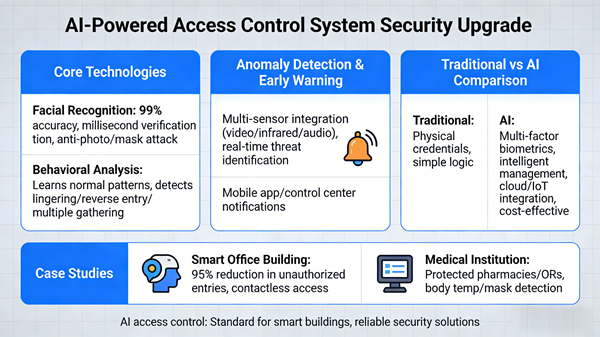
One core technology of AI access control systems is deep learning-based facial recognition. Compared to traditional identification methods, AI-driven systems can complete identity verification within milliseconds, with accuracy rates exceeding 99%. This technology not only resists photo, video, or mask attacks but also adapts to varying lighting conditions, angles, and facial expressions.
For example, after a commercial building introduced AI facial recognition access control, authorized personnel entry and exit times were reduced by an average of 70%, while tailgating risks were eliminated. This efficient recognition brings significant convenience to daily operations while strengthening the foundational defense of security systems.
How Behavior Analysis Enhances Security Levels
Beyond identity verification, AI can further enhance security protection through behavior analysis. Systems can learn normal entry and exit patterns and identify abnormal behaviors, such as prolonged loitering, reverse entry, or crowd gathering. This intelligent analytical capability shifts security systems from passive response to proactive prevention.
In practical applications, AI access control systems can monitor entrance areas in real-time, triggering alarms or notifying security personnel immediately upon detecting suspicious behavior. This behavior analysis is applicable not only to office buildings but also widely used in high-security venues like hospitals and schools.
Anomaly Detection and Real-Time Alert Functions
Anomaly detection is another highlight of AI in the access control field. Systems can integrate data from various sensors, including video, infrared, and audio, using machine learning algorithms to identify potential threats. For instance, when detecting unauthorized door attempts, equipment failures, or environmental anomalies, the system automatically issues real-time alerts.
This real-time alert function significantly reduces emergency response times. Management personnel can receive notifications via mobile apps or control centers and take swift action. This not only enhances security levels but also reduces human monitoring costs.
Comparison with Traditional Access Control Systems
Traditional access control systems primarily rely on physical credentials and simple logic controls, lacking intelligent analytical capabilities. In contrast, AI artificial intelligence-driven systems offer the following advantages:
- Higher Security: Multi-factor authentication combined with biometric features, making forgery or hacking difficult.
- Intelligent Management: Automated authorization updates, access record analysis, and risk assessment.
- Flexible Scalability: Supports cloud integration and IoT device connectivity for easy system upgrades.
- Cost-Effectiveness: Reduces manual intervention and maintenance costs in long-term operations.
Practical Application Case Studies
Case 1: Smart Office Building
A multinational enterprise deployed an AI access control system at its Hong Kong headquarters, integrating facial recognition with behavior analysis. After implementation, unauthorized entry incidents decreased by 95%, while employee satisfaction improved due to contactless access. Management also utilized system data to optimize space usage, extending the business value of security enhancement solutions.
Case 2: Healthcare Facility Security Upgrade
A large hospital introduced AI-driven access control, focusing on protecting high-risk areas like pharmacies and operating rooms. Through anomaly detection, the system successfully prevented multiple potential security incidents and supported temperature checks and mask recognition during the pandemic, demonstrating multifunctional adaptability.
Conclusion: Future Prospects of AI Access Control
AI artificial intelligence is redefining the security standards of access control systems. From precise identification to intelligent alerts, these technologies not only enhance protective capabilities but also provide data-driven decision support for building management. As algorithms continuously optimize and hardware costs decline, AI access control will become a standard feature of smart buildings, offering more reliable and efficient security system solutions for various industries.
For building managers and security users, investing in AI access control is not only a technological upgrade but also a proactive response to future security challenges. By selecting appropriate AI access control system security enhancement solutions, organizations can protect assets and personnel while improving operational efficiency and business competitiveness.
































Featured comments
No comments yet. Be the first.
Leave a comment
Bold and lists OK; no external scripts or images
0 / 2000
Comments appear after moderation