排班(排更)系統的实际应用和设计排班系统的技巧
設計與選擇排班系統的關鍵技巧

考勤与薪酬管理系统
考勤、薪酬、门禁、多功能集成系统,助力企业降本增效! Details
整合自动化考勤与薪酬计算, 高度安全的流程化,保障薪酬计算安全可控, 请假排班,多分支,连锁,分销, 多账目,功能全面。
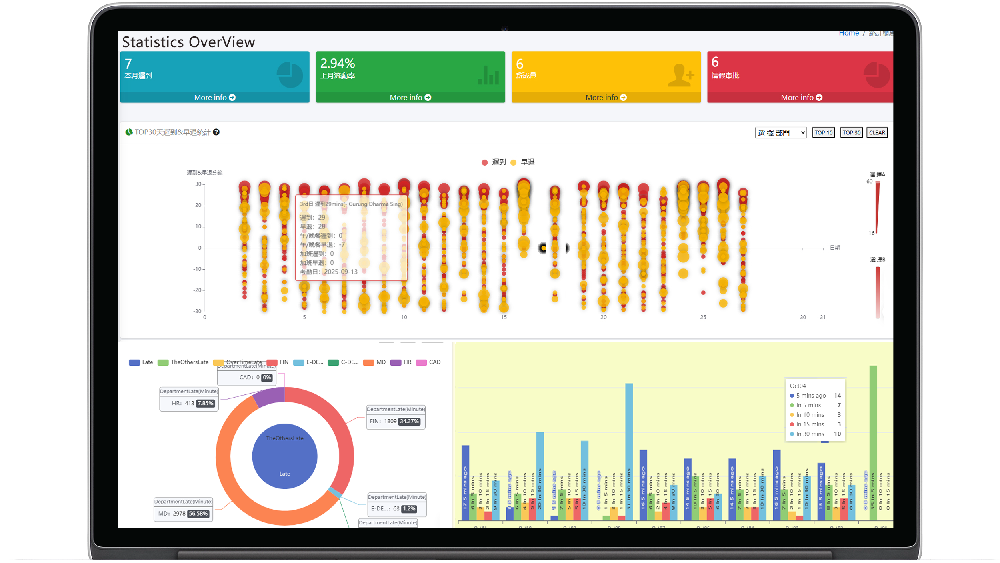
Practical Applications and Core Design Techniques of Scheduling Systems
In modern enterprise operations, efficient human resource management is key to maintaining competitiveness. Among these, the scheduling (shift scheduling) system, as a core tool connecting human resource planning and actual operations, is undeniably important. A well-designed scheduling system can not only optimize manpower allocation and control costs, but also improve employee satisfaction and operational efficiency. This article will delve into the practical application scenarios of scheduling systems and share practical techniques for designing and selecting such systems.
Wide Application Scenarios of Scheduling Systems
Scheduling systems are widely used across various industries, playing an indispensable role, especially in industries with high manpower flexibility requirements.
- Retail and Food Service Industries: These industries require flexible manpower allocation to accommodate holidays, peak seasons, and daily peak and off-peak periods. The system can assist managers in quickly arranging different shifts (early shifts, late shifts, holiday shifts) while ensuring compliance with minimum manpower requirements, and handling the complex availability of part-time staff.
- Medical Care Institutions: Nursing staff scheduling must strictly adhere to legal working hours, taking into account professional levels, departmental needs, and the fairness of consecutive shifts. The system can assist in planning long-term three-shift systems and automatically avoid the risks of overtime work.
- Manufacturing and Logistics Industries: Facing order fluctuations, flexible adjustments to production line or warehousing logistics manpower are necessary. The system can provide cross-departmental or cross-team support scheduling to meet project or order requirements.
- Customer Service Centers: Customer service staff schedules need to be accurately arranged based on call forecasting models to ensure service levels. The system can implement skills-based scheduling, assigning employees with specific skills to corresponding service hours.
Regardless of size, the purpose of implementing scheduling management tools is to automate and visualize tedious manual planning, reduce human error and disputes, and allow managers to focus more on strategic human resource analysis.
Key Strategies for Designing and Selecting a Scheduling System
Choosing or designing a suitable enterprise scheduling solution requires starting from the company's actual needs and considering the system's integration and scalability. The following are key evaluation areas:
1. Core Functionality: From Automation to Intelligence
A basic scheduling software should provide an intuitive drag-and-drop scheduling interface, shift templates, and employee availability management. Advanced automatic scheduling functions can automatically generate preliminary schedules based on preset rules (such as work hour limits, skill matching, and rest interval regulations), significantly saving time. Intelligent systems can further integrate historical operational data to predict demand and achieve optimized scheduling based on demand.
2. Seamless Integration: Building a Unified Human Resource Management Ecosystem
Scheduling should not be an information silo. An excellent system must be deeply integrated with other human resource management modules. This includes:
Integration with Attendance Systems: The generated schedules can be directly used as a comparison benchmark for clock-in/out systems, enabling accurate automated attendance systems that calculate attendance, lateness, absences, and overtime hours.
- Integration with Payroll System: Seamlessly transfer attendance results, especially complex overtime and holiday overtime hours, to the payroll system or HR payroll system for accurate payroll calculation. This integrated attendance and payroll system is key to eliminating errors and improving HR efficiency.
- As Part of an HRMS System: Integrate the scheduling module into a complete Human Resources Management System (HRMS) or HR software to uniformly manage employee information, leave applications, performance, etc., ensuring data consistency.
3. Compliance and Flexibility: The system must be able to set and comply with local labor laws, such as Hong Kong's Employment Ordinance regarding rest days and overtime compensation. At the same time, it must provide flexibility, allowing for the handling of temporary shift changes, shift swaps, and special cases, while maintaining a complete approval log.
4. Employee Engagement and Accessibility: Modern scheduling applications emphasize the employee experience. Through mobile applications, employees can view their personal schedules, submit available time, and apply for shift changes or leave at any time, improving communication efficiency and work autonomy. Managers can also issue notifications instantly to ensure information synchronization.
5. Cloud Deployment and Cost Considerations
For SMEs, initial investment costs are crucial. Seeking a free trial or basic free version of an attendance system or HR management system is a good way to reduce risk. Cloud-based payroll systems and SaaS-based HR systems can reduce hardware investment and maintenance costs, significantly lowering the barrier to entry for SMEs' payroll systems and employee attendance management software. In the Hong Kong market, choosing a Hong Kong-based attendance system solution with good localization services, support for Traditional Chinese, and compliance with Hong Kong law can avoid subsequent compatibility issues.
Conclusion
In conclusion, an effective scheduling system is not only a tool for scheduling shifts, but also a strategic work scheduling tool that drives operational efficiency, ensures compliance, and improves employee satisfaction. When evaluating a system, companies should focus on its level of intelligence, its integration capabilities with existing attendance and payroll systems, regulatory compliance, and whether it provides a platform that promotes employee collaboration. Whether choosing specialized scheduling software or implementing a complete Human Resource Management System (HRMS), the core objective is to optimize human resource processes through technology, enabling companies to respond more agilely to market changes and maximize the value of human capital.






























精选短评
尚无短评,欢迎留下第一则。
写短评
支持粗体、列表;勿贴外部脚本或图片
0 / 2000
提交后需审核才会公开显示